
Introduction:
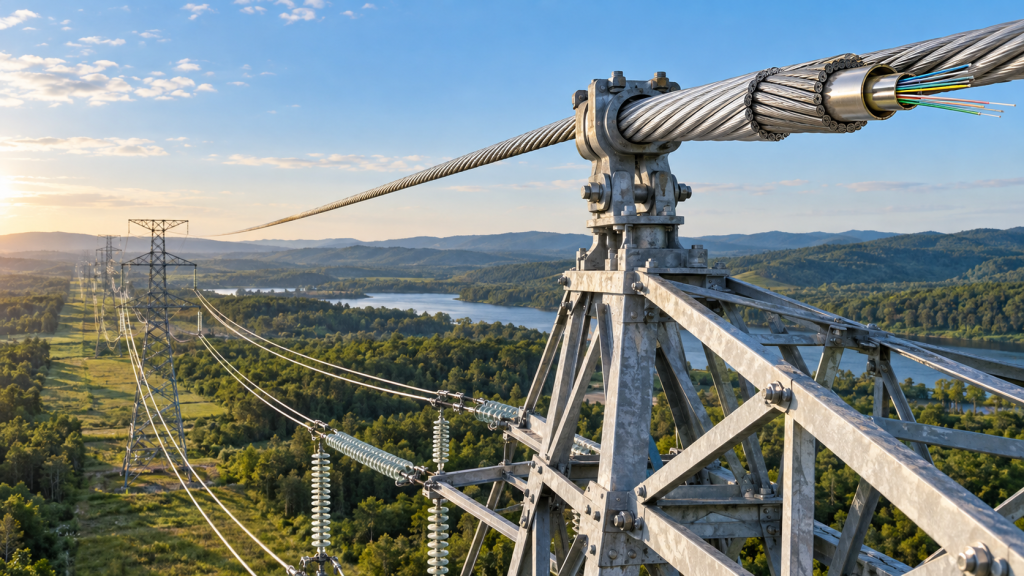
An OPGW cable sits at the top of a transmission tower and handles two
jobs at once: ground-wire duty and fiber communication.
For
a transmission line electrical design engineer, that top position is
the first thing to understand. It is where the shield wire normally
sits, where lightning and fault current find a path to earth, and
where a fiber route can travel for many kilometers without needing a
separate tower or trench. An OPGW cable keeps that ground-wire role
and adds a communications channel inside the same stranded metal
structure. The result is one overhead cable that protects the line,
conducts fault current, and carries optical signals, while staying
separate from the phase conductors that move bulk power. this guide
explains that dual duty step by step, from tower-top position to
cable construction to the 24-core G. 652D fiber link inside.
Why
an OPGW Sits at the Top of a Transmission Tower
A
high voltage transmission tower usually has phase conductors at lower
positions and one or more ground wires at the very top. The top
position is not random. It is chosen so the ground wire can intercept
lightning strikes before they reach the phase conductors. When a
strike hits the top wire, the current is directed toward the tower
structure, down the tower, and into the grounding system. That shield
wire also gives fault current a low-impedance path during certain
system events. An OPGW cable takes the same top position because it
is built to perform that same ground-wire duty. That position also
makes OPGW a natural host for fiber. The cable runs along the
transmission corridor from tower to tower, already supported by the
tower top and already connected to the grounding path. Instead of
finding a separate route for communications, a utility can put
single-mode fibers inside the ground wire itself. The fibers do not
carry electrical power. They carry optical signals for protection,
control, and monitoring. The cable still sits above the phase
conductors, still works as a shield wire, and still connects to the
tower grounding system. It is not a phase conductor, and it does not
move bulk electricity from generation to load. Its role is
ground-wire duty plus communications, not power delivery. For a
design engineer, this explains why OPGW appears in the same place as
a conventional ground wire. The tower top is the electrical shielding
point and the mechanical support point. The same cable can then serve
the communication system without changing the tower’s basic layout.
That is the first step in the concept ladder: position first, then
electrical duty, then fiber function.
How
the Ground Wire and Fiber Channel Share One Cable
The
interesting part of OPGW is not just that it sits at the top. It is
how the metal ground-wire function and the optical fiber function
coexist without interfering with each other. The cable uses a layered
construction. The fibers are placed in a protected optical unit, and
the outer layers are made from stranded metal wires. The metal layers
give the cable its tensile strength and its ability to carry current.
The optical unit keeps the fibers in a controlled location so they
can transmit light signals over long distances. The two duties share
the same cable body, but they are separated by design.
1.
The Metallic Loose-Tube Unit Keeps Fibers Separate from Stranded
Armor
Inside
an OPGW cable, the optical fibers are not loose among the outer
aluminum and steel wires. They sit inside a metallic loose-tube
optical unit. That tube gives the fibers a protected channel and
keeps them away from the stranded metal armor that surrounds it. The
tube also allows the fibers to sit with some controlled length and
movement inside the cable, which matters because the cable
experiences tension, vibration, and temperature changes in overhead
service. The outer strands can carry mechanical load and fault
current, while the fibers remain in their own optical path. This
separation is what lets a single cable act as both a ground wire and
a fiber link. The metal tube is part of the cable’s strength and
sealing strategy, and the fiber unit is the communication heart
inside it.
2.
Aluminum-Clad Steel and Aluminum Alloy Strands Carry Fault Current
The
outer layer of a typical OPGW cable uses aluminum-clad steel wires
and aluminum alloy wires stranded together. The aluminum-clad steel
wires give the cable high tensile strength and a conductive path. The
aluminum alloy wires add conductivity and help the cable handle
outdoor exposure. When lightning hits the line or a fault occurs,
current can travel through these outer metallic strands, through the
tower, and into the grounding system. The fibers are not part of that
electrical path. They stay inside the metallic loose tube while the
stranded armor does the electrical and mechanical work. The exact
short-circuit capacity, diameter, and rated tensile strength depend
on the project design, but the basic principle is consistent: the
metal strands conduct, and the optical unit communicates. That split
duty is why OPGW can look like a standard ground wire from the
outside while containing a fiber communication path inside. The outer
strands are not just a protective jacket. They are the electrical
conductor for ground and fault current, and they are also the
structural member that carries the cable across spans. The inner
metallic tube is not a power conductor. It is the protected home for
the fibers. This layered arrangement is the core of the dual-duty
design.
What
a 24-Core G.652D OPGW Does in Utility Communications
A
24-core G. 652D OPGW cable carries 24 single-mode optical fibers
inside the same ground-wire structure.G.652D is a widely used
single-mode fiber standard for utility and telecom networks. It
supports long-distance transmission with low attenuation in the
standard single-mode windows, which makes it suitable for
substation-to-substation links, SCADA channels, teleprotection
signals, and grid monitoring traffic. In a transmission line project,
24 cores give the utility room to separate critical protection
channels from general operational traffic. Some fibers can be used
for teleprotection, some for SCADA, and some can remain spare or be
used for future capacity. The fiber count does not change the cable’s
top-of-tower position or its ground-wire duty. It simply defines how
many optical channels travel inside that ground wire. A useful
product example is the JIQIAN Fiber Optic Cable JQ OPGW 24 Core. It
uses 24 ITU-T G. 652D single-mode fibers, a metallic loose-tube
optical unit, and aluminum-clad steel plus aluminum alloy stranded
armor. It follows IEEE 1138 and IEC 60794-4-10 and is designed for
overhead transmission lines and utility communication. Those facts
show how a real 24-core design brings together the three layers this
guide has described: tower-top ground-wire position, stranded metal
conduction, and protected single-mode fiber. Exact diameter, RTS,
short-circuit capacity, and drum length are project-specific, because
a transmission line design sets those values from span, fault level,
and site conditions. For a design engineer, the practical value is
clear: one cable can serve the ground-wire function and provide a
24-core single-mode communication path without becoming a phase
conductor.
Conclusion
An
OPGW cable works because the top of a transmission tower already has
a job for it. That position shields the phase conductors, carries
lightning and fault current toward the grounding system, and follows
the line corridor from tower to tower. By placing a metallic
loose-tube optical unit inside a stranded aluminum-clad steel and
aluminum alloy armor, the cable adds a fiber communication channel
without giving up its ground-wire role. A 24-core G. 652D version
then provides 24 single-mode fibers for utility communications such
as SCADA, teleprotection, and substation links. It is still not a
phase conductor and does not carry the main power load. The exact
electrical and mechanical values belong to the project design, but
the dual-duty principle stays the same: ground wire outside, fiber
link inside, one cable at the top of the tower.
FAQ
Q:What
is the main function of an OPGW cable on a high voltage transmission
line?
A:An
OPGW cable sits at the top ground-wire position and performs two main
functions. It shields the phase conductors and gives lightning and
fault current a path toward the tower grounding system, and it
carries optical fibers for utility communications. It does not carry
the main power load and is not a phase conductor.
Q:Why
does an OPGW cable combine metallic strands with optical fibers?
A:The
metallic strands give the cable the tensile strength and electrical
conductivity needed for overhead ground-wire duty. The optical
fibers, protected inside a metallic loose tube, provide a
communication channel along the same transmission corridor. Combining
them avoids a separate fiber route and lets one cable serve both the
grounding system and the utility network.
Q:How
is a 24-core G.652D OPGW different from a phase conductor?
A:A
phase conductor carries bulk electrical power at high voltage between
generation and load. A 24-core G. 652D OPGW is installed at the tower
top as a ground wire and communication cable. It may carry fault
current during an event, but it does not carry normal load current.
Its 24 G. 652D fibers carry optical signals, not electrical power.
Sources
/ References
G.652:
Characteristics of a single-mode optical fibre and cable
Related
Examples
JIQIAN
OPGW 24 Core G652D Fiber Optic Ground Wire for Overhead Transmission
Lines
